Calibre by Andes
Inside Calibre.
Inside Calibre
Open the watch.
One Node.js process and one SQLite file on the outside. Six engineered layers inside. Choose a layer to see what it does.





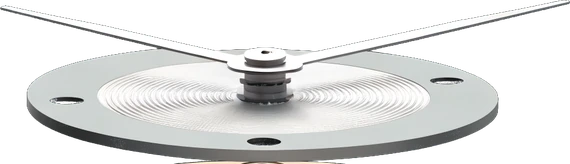
Watch film and exploded render: AI-generated illustration. Lucy's case and all sample details are illustrative.
Deployment and inference
Your boundary. Your cloud.
Your choice of model.
For a private deployment, agree where Calibre runs, which model each action may use, and what it may receive. Provider retention terms apply.
Customer-controlled environment
- On-premises
- AWS
- Azure
- Google Cloud
Application
One Node.js process. Campaigns, cases, reviews and boards.
Case store
One SQLite file. Records, facts and audit history.
Explicit reader
Selected institutional rulebooks and your own. The explicit logic needs no model call.
- Identity
- Anonymous, private code or named
- Access
- Scoped tokens and delegation links
- Boards
- Small groups suppressed
- Copies
- Your exports and backups
Only what you permit crosses the line
Illustrative payload
"I use a transcription app on my own card because the approved tool misses our dialect."
Example payload: the description, without a name or return code. Free text can still contain identifying information; review what is shared.
Private inference, per action
Private-deployment configuration. The diagram sends no data and makes no model call.
- Bring your own key. Agree the endpoint, permitted payload and retention terms for each action.
- Without inference, intake and explicit readings still work.
- Cloud and model names identify deployment options, not partnerships or endorsements.
The rulebook
A rulebook is a movement.
Assembled once, then it keeps time.
Each clause is reviewed, turned into explicit questions and logic, and then read the same way on every case. Follow one rule through Lucy's case.
Illustrative company rule, not a legal requirement. In this example, client meeting data is already confirmed to be in scope. Only contract coverage changes.
- 01
Source
The clause and its revision
"Client data may only go to an approved processor."
- 02
Reviewed meaning
Scope, checks and exceptions
Applies when client data leaves the company.
- 03
Questions
The facts the rule needs
Does the vendor contract cover client meeting data?
- 04
Explicit logic
Conditions, written out
conditions_met = covered
AND in_scope - 05
Reading
Open
Procurement must answer before the owner can decide. Unknown is not no.
- Pinned revision
- Unknown never becomes no
- Digests flag a changed basis
- Tested on known cases
- A person owns the conclusion
Calibre by Andes
Give AI use a way
to be understood.
People are trying tools, building shortcuts and finding better ways to work. Calibre gives them a place to explain what they do, and gives your organisation a way to review it.
The demonstration uses fictional company records. It accepts no live employee contribution.
Two ways to explore Calibre.
Choose the surface that fits your question.
System 01 / Practitioner workbench
Open the Calibre practitioner workbench.
Open System 01System 03 / Organisation review
Explore a fictional organisation in a read-only demo. Do not enter company information.
Open the read-only organisation demo
Start with their words.
Keep the questions.
A missing fact is a reason to ask, not a reason to invent an answer.
Describe the work.
An employee explains the tool, information and purpose in ordinary language. Their original wording stays beside what was understood.
Employee-reported use, not automatic surveillance.Read the relevant rules.
Selected rulebooks bring regulatory requirements and other review criteria to the same case. Different reading states remain distinct.
A reading is not a compliance score.Ask what is missing.
An unknown account, data category or operating detail stays open. The people who know the work help complete the picture.
Unknown is not no.A person decides.
A named reviewer records their decision, conditions and review date. The organisation owns the conclusion and what happens next.
Human judgement stays visible.
One case in the demo
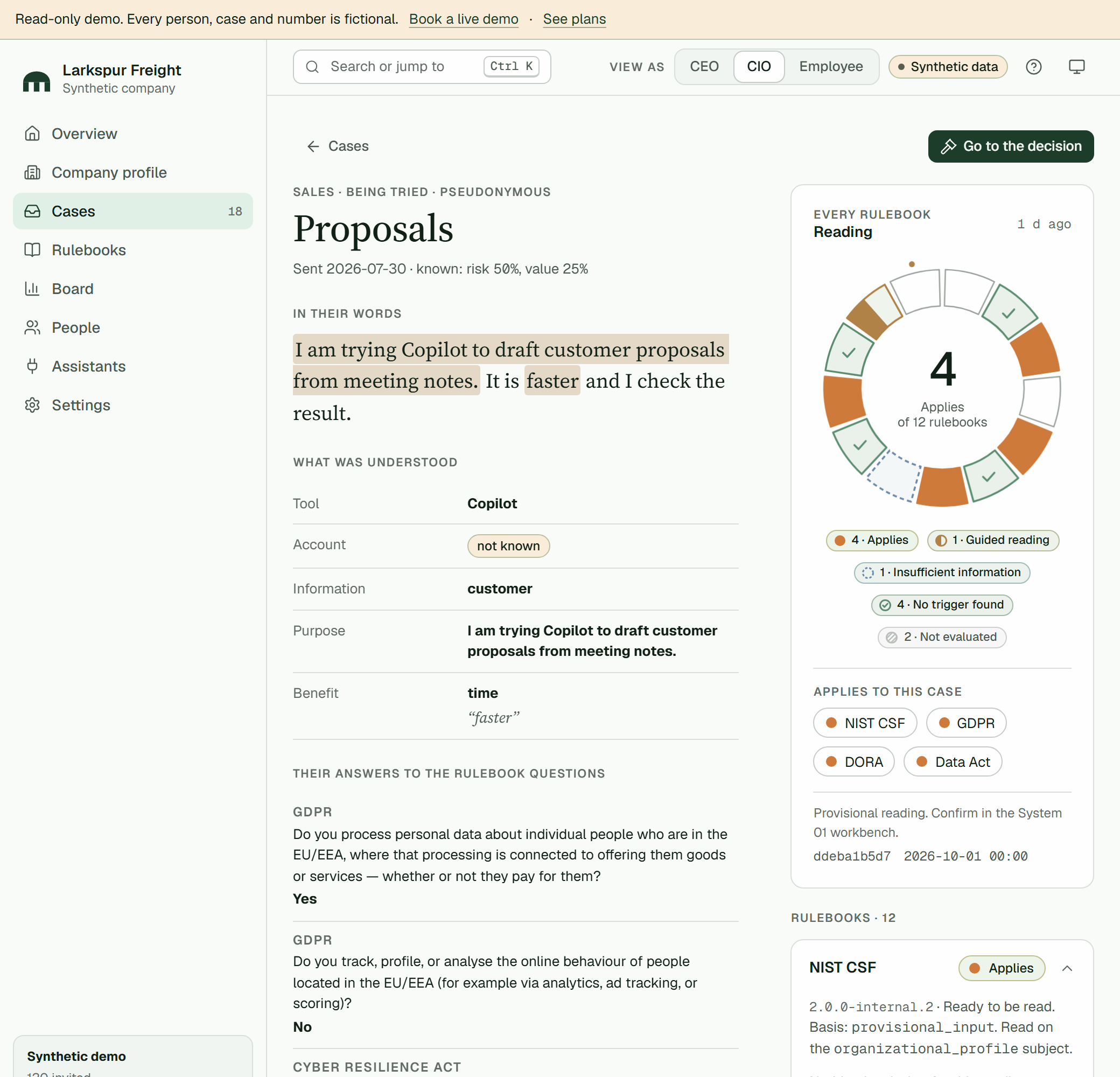
A proposal drafted with Copilot.
The tool is known. The account is not. See the employee's sentence, the product's reading and the empty decision form in the same case.
Rulebooks
Different sources.
Different meanings.
Calibre's rulebooks are also called cartridges. Reading a standard does not confer certification.
- 01Laws and regulations
Read the requirements that may apply to the use, role and jurisdiction.
- 02Certifiable standards
Review management-system criteria. Certification belongs to the relevant assessment process.
- 03Voluntary practices
Use guidance to ask better questions and structure the work.
For your organisation
Agree the delivery
with Andes.
Discuss the licence, operating responsibilities and data-handling requirements for a private deployment.
Calibre supports review against selected rulebooks. The customer owns the compliance decision.
Trust and responsibilityQuestions organisations ask.
What the workflow does, and where human responsibility stays.
Does it monitor every AI tool employees use?
No. Calibre handles employee-reported use. It does not automatically discover undeclared tools or monitor employee activity.
Does a rulebook reading approve the use?
No. Selected rulebooks inform the review. A named person in the organisation makes and owns the decision, including any conditions and review date. This is not legal advice or certification.
Can we use the public demo with company data?
No. The public demonstration is fictional and read-only. It accepts no live employee contribution and does not let visitors change a decision. Private delivery is agreed separately with Andes.
Review delivery and responsibility